When illness becomes a bill: why medical debt is a public health crisis
For millions of Americans, illness doesn't just take health, it takes stability.

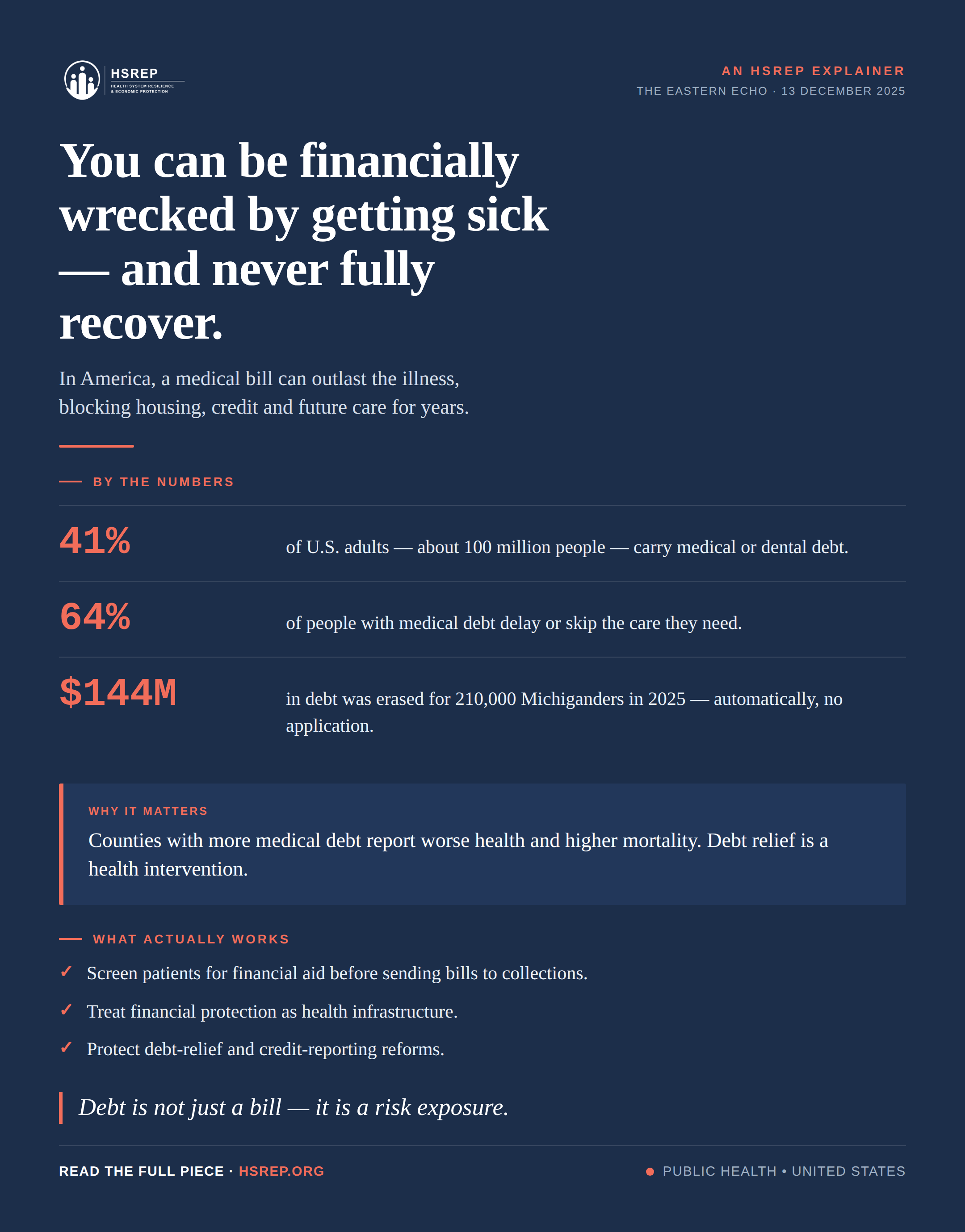
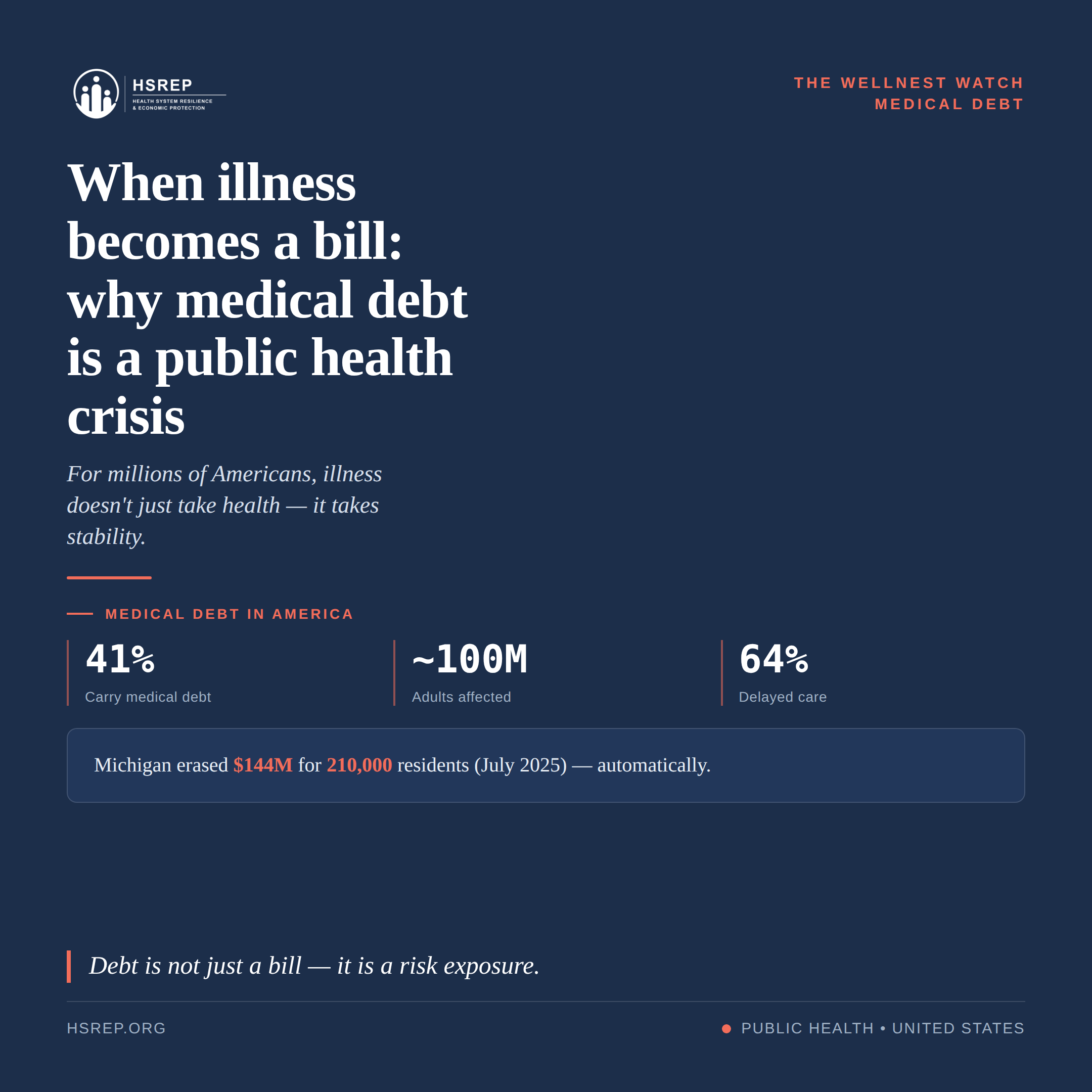
- 41% of U.S. adults, roughly 100 million people, carry medical or dental debt, and 64% of those with debt delay or skip care because of cost: an epidemic of avoidance.
- Debt damages health, not just credit: counties with higher medical debt report worse physical and mental health and higher mortality (JAMA Network Open, 2024).
- Michigan showed debt relief is a public health intervention: $144 million erased for 210,000 residents, automatically, while federal protections appear and vanish overnight.
- Medical debt is a failure of system design, not biology: true prevention protects people from both illness and insolvency.
Imagine needing urgent care and receiving a bill that derails your finances for years. For millions of Americans, illness doesn't just take health; it takes stability.
When getting better becomes a debt trap, medical care itself becomes a public health risk. A 2022 Kaiser Family Foundation study found that 41% of U.S. adults currently have medical or dental debt, which translates to roughly 100 million people when applied to the adult population.
That is nearly two in five adults. Many of whom owe lenders, credit card companies, or collection agencies because of hospital bills they couldn't afford to pay.
The same 2022 Kaiser Family Foundation study reported that about one in three adults, 35%, delayed or skipped needed medical care because of cost. Among adults with medical debt, the share was even higher, at 64% putting off treatment due to financial pressure.
Medical debt in America
This is not a fringe problem; it is an epidemic of avoidance. And like most epidemics, it hits hardest along existing fault lines. Black and Hispanic households, low-income families, women, and people without insurance are disproportionately burdened. Every unpaid bill becomes another barrier to future care.
Medical debt does more than damage credit scores; it damages health.
A 2024 study, published by the medical journal JAMA Network Open, found that counties with higher rates of medical debt reported more days of poor physical and mental health, along with higher mortality.
Chronic stress, anxiety and depression walk hand in hand with debt. Families skip medications or appointments to stay afloat. In many cases, being sick means choosing which illness to address: the physical one or the financial one. Even after people recover medically, the economic fallout lingers.
Medical debt blocks housing, reduces credit scores and traps families in instability. In public health terms, debt is not just a bill; it is a risk exposure.
In public health terms, debt is not just a bill; it is a risk exposure.
Michigan confronted this reality directly. In July 2025, the state erased $144 million in medical debt for about 210,000 residents through a partnership with the nonprofit Undue Medical Debt. Qualifying residents did not need to apply; the relief was automatic. In Kalamazoo County alone, more than 7,200 people saw $2.4 million in debt wiped out in a single quarter.
In Ypsilanti, where students and families juggle tuition, rent and part-time jobs, an unexpected emergency-room bill can cause real damage. Medical debt does not just shape physical health; it shapes graduation timelines, stress levels and housing stability. Michigan's action recognizes something long ignored: Debt relief is a public health intervention.
Yet policies meant to protect patients remain unpredictable. In Jan. 2025, federal regulators proposed removing medical debt from credit reports nationwide, only for the rule to be struck down by a court six months later. Protections differ across states and hospitals vary widely in how they screen patients for financial assistance. When basic safeguards can appear and disappear overnight, families remain exposed. Medical debt becomes not only a financial burden but a policy vulnerability.
International comparisons from the Commonwealth Fund's Mirror, Mirror 2024 report and analysis from the Peterson-Kaiser Family Foundation Health System Tracker show the same pattern: The U.S. spends more on health care than any other high-income country, yet Americans live shorter lives and experience more preventable illness.
Part of this paradox lies in financial toxicity, where the cost of care becomes a disease in itself. Some reforms offer hope. Medicaid expansion reduces medical debt and strengthens financial stability.
The federal No Surprises Act limits unexpected out-of-network bills. State-level bans on medical debt credit reporting, such as in Colorado and New York, have dropped reported collections to zero. But these gains remain uneven and insurance designs continue to push people toward high deductibles and unpredictable billing.
Medical debt is a failure of prevention: not of biology, but of system design. True prevention means protecting people from both illness and insolvency. Local hospitals can help by automatically screening patients for financial assistance before sending bills to collections. Universities like Eastern Michigan can strengthen support for students who are navigating insurance, billing confusion, and rising healthcare costs. And policymakers should treat financial protection as part of public health infrastructure, as essential as vaccines, clean water, or safe housing.
When illness becomes a bill, recovery is never complete. The debt does not stay on paper; it lives in bodies, minds and neighborhoods. Public health must reclaim its purpose: Preventing harm before it begins, even when that harm arrives in an envelope marked balance due.
Corrections & clarifications
- The article says federal regulators proposed removing medical debt from credit reports in January 2025 and that a court struck the rule down six months later. The sequence was slightly different. The Consumer Financial Protection Bureau proposed the rule in June 2024 and finalized it on 7 January 2025. It never took effect. A federal court in the Eastern District of Texas vacated it on 11 July 2025 in a consent judgment the bureau itself agreed to, rather than over the bureau’s objection. The rule remains vacated.
- The article attributes to the 2022 Kaiser Family Foundation Health Care Debt Survey a finding that about one in three adults, 35 percent, delayed or skipped needed care because of cost. That survey publishes no all-adults total for that question. What it reports is a split by debt status: 64 percent of adults with medical debt put off or skipped care they needed, against 28 percent of adults without such debt. The 64 percent figure quoted in the article is correct.
This piece is reproduced as it was originally published. Where a figure or an attribution needs correcting, HSREP records the correction here rather than editing the published text. Each dated note above links to its entry in the HSREP corrections log.