Printed from hsraep.org/initiative.html · version dated 23 October 2026 · Prevention Adoption Initiative, an HSREP initiative in development · every tab and question on the page is expanded in this printout.
HSREP (Health System Resilience and Economic Protection) is an independent public-health research and advocacy platform based in Michigan. This pilot is its first applied project.
The gap between care recommended and care finishedFrom a recommended test to a finished one.
Health centers already know what gets people screened for colorectal cancer. What fails is follow-through: kits that never come back, and positive results that never reach a colonoscopy. The Prevention Adoption Initiative proposes a weekly routine, run by a clinic’s own staff, that closes those gaps.
Why one clinic matters. Health centers served more than 32.7 million patients in 2025, and every one reports the same colorectal screening measure to HRSA; from 2027 a HEDIS measure also counts whether a positive test reached a colonoscopy. Why execution, not a new method. In the largest health-center trial, one mailed-kit programme moved completion anywhere from −7 to +18 points across 26 clinics, depending on how well each clinic carried it out. This pilot works on the carrying out, and writes down what it takes so another clinic can repeat it.
- We ask
- One Michigan health center to host a 12-month pilot on one completion gap: colorectal screening by default, or one your clinic chooses. A nightly coded export, no names or dates; the code key stays with your IT lead.
- You pay
- For my time, under a written agreement: a feasibility rate for months 1 to 3 (planning range $8,000 to $10,000), the full rate from month four if you continue (about $45,000 to $60,000 for months 4 to 12). Plus kits, postage, texts and your staff’s time, as now.
- You get
- A weekly list of who is overdue and why, scripts and training for your staff, and an independent evaluation of a measure you already report, by an academic partner still to be confirmed.
- The evaluation
- Paid separately, from an academic partner’s own grant, once one is confirmed. The clinic pays for my time as implementation lead; HSREP adds no fee on top.
Led by Md Shafaat Ali Choyon, MBA, MCIM, MPH, CHES®. Seventeen years getting people to follow through, in health care since 2021. Why I can do this
- 1Due for screeningAge 45 to 75, not up to date
- 2Stool-test kit mailed homeWith a reminder in their language
- First gap: many kits never come back
- 3Test returned and read
Start with your part
The pilot needs three partners. Pick one to see what it would mean for you.
Time from your existing outreach staff, sized with you at the start. No new hires. As a working estimate, for a panel of a few hundred overdue patients: five to eight hours a week of outreach staff time in the feasibility phase, 30 minutes a week from your quality-improvement lead, and about half a day, once, from your IT lead to map the file.
A quality-improvement lead who meets with me weekly.
A written agreement before month one: the scope, a feasibility rate for months 1 to 3, and the full rate from month four if you continue.
A decision at month three, with the feasibility measures in front of us: continue, or stop. Nothing is billed after the month you stop.
One nightly export from your IT lead, mapped once: 19 coded columns, no names, record numbers or dates. The list that links codes to patients never leaves your clinic. Data spec below.
Outreach costs: kits, postage and texts.
The money can come from your own budget, a Medicaid plan’s quality-incentive dollars, or a grant your clinic holds.
About twenty hours a week of hands-on work with your staff in the feasibility phase, and about thirty a week from month four if you continue: scripts that people act on, training, and a next step for every patient who stalls.
A weekly list of who is overdue, and why.
Co-authorship for your quality-improvement lead on what is published, by contribution (ICMJE), and your clinic named only if it chooses.
An independent evaluation of a measure you already report.
No host site or academic partner is confirmed yet. The pilot can start with a host site alone; the independent evaluation needs an academic partner, and without one the result is reported as the clinic’s own before-and-after.
- Before month 1 · setupWhat you set up
- A 30-minute conversation, then a written agreement: the scope, the two rates, and the decision at month three.
- Name a quality-improvement lead and the outreach staff who will work with me.
- Your IT lead maps the 19 columns once.
- The evaluator, if one is confirmed, measures the starting point and publishes the plan.
- Months 1–3 · feasibilityWhat your staff do
- Make the calls, mail the kits and navigate patients, as now, with me beside them about twenty hours a week.
- Your QI lead gives me 30 minutes a week.
- You cover kits, postage and texts.
- Month 3 · decisionWhat you decide
- We review the feasibility measures together.
- If the feasibility measures are met, you decide whether to continue to month twelve. If not, we stop. Nothing continues by default, and nothing is billed after the month you stop.
- Months 4–12 · if continuedWhat you get
- A month 6 readout and a month 12 evaluation, published whichever way they go, with your clinic named only if it chooses.
- A second person on your team trained to keep the list.
- By month twelve your staff run the routine without me. If it did not work, you go back to how you worked before.
Own the evaluation independently, with IRB approval.
Set the protocol. Working assumption: before and after against the site’s own trend, with a comparison clinic where possible, reported with RE-AIM.
Publish the plan before the pilot starts.
A real-world completion pilot in a federally qualified health center, and the implementation-science question of how well each step is carried out.
Authorship by contribution, on the ICMJE criteria.
The evaluation is paid from your own grant, not by the clinic or by me. The clinic pays for the implementation.
Still open: the comparison clinic and the target.
- Before month 1 · setupWhat you set
- A 30-minute conversation on the design.
- The protocol: before and after against the site’s own trend, a comparison clinic where possible, reported with RE-AIM.
- IRB approval, and an agreement with the clinic for a de-identified evaluation extract.
- A grant for the evaluation, held by your institution. It pays for the evaluation only. The pilot does not wait for it: the clinic’s reported screening rate is the starting point you inherit.
- The target, set in advance, and the plan published before the pilot starts.
- Months 1–3 · feasibilityWhat you watch
- The feasibility measures: kits sent and returned, positives navigated and booked, days from a positive test to a booking, staff hours, file completeness.
- No outcome claims yet. Three months cannot show that rates rose.
- Month 3 · decisionWhat you judge
- Your independent read of the feasibility measures goes into the site’s decision to continue or stop.
- Months 4–12 · if continuedWhat you report
- Month 6: first readout. Month 12: final evaluation against the published target.
- Results published whichever way they go, with authorship by contribution.
- Still open with you: the comparison clinic and the target.
Fund one of two things, with a gate at month three. A grant to the host clinic pays for the implementation: my time, materials and outreach. A grant to the academic partner pays for the independent evaluation.
Either way the clinic carries its own staff time. Money for months 4 to 12 is released only if the feasibility measures are met.
Criteria for further investment, agreed before results.
Who this fits: a Medicaid plan’s quality-incentive dollars, a Michigan health foundation, or an MDHHS subaward under CRCCP.
A published benchmark to compare against: mailed-kit outreach at $54.83 direct per patient screened, $72.90 with overhead, about $91 per additional person screened once background screening is netted out (Pignone et al., JGIM 2021, 2019 dollars). Not the pilot’s cost; the feasibility phase measures that.
Results published whichever way they go.
- Before month 1 · setupWhat you agree
- A 30-minute conversation.
- The criteria for further investment, agreed before any results exist.
- The application, with the clinic’s agreement and, for the evaluation, the evaluator’s plan.
- Months 1–3 · feasibilityWhat you watch
- Only the feasibility phase is spent before the gate.
- You see the published plan and the feasibility measures as they come in.
- Month 3 · decisionWhat you decide
- If the feasibility measures are met, months 4 to 12 are released.
- If they are not, nothing more is spent and nothing continues.
- Months 4–12 · if continuedWhat you get
- A month 6 readout and a month 12 evaluation, published whichever way they go.
- A published benchmark to compare against: mailed-kit outreach at $54.83 direct per patient screened, $72.90 with overhead, about $91 per additional person screened (Pignone 2021, 2019 dollars). Not the pilot’s cost; the feasibility phase measures that.
- A routine the site’s own staff run after month twelve.
Two problems, measured on two different groups.
Only about 8% of U.S. adults 35 and older receive all fifteen high-priority preventive services (Borsky et al., Health Affairs, 2018). Colorectal cancer screening is the part this pilot takes on. Screening completion counts everyone who is due. Follow-up counts only people whose test came back positive. They are not steps of one funnel, so this page never multiplies them.
Age ranges differ: health-center data (HRSA UDS) has covered ages 45–75 since 2023. Close measures, not identical ones.
Shown as a range because studies disagree. NCQA now measures it: COF-E, new for HEDIS MY2027, counts colonoscopy after a positive test for ages 45–75 (180 days in the draft specification; the evaluator will check the final one before any formal alignment is claimed).
In the largest real-world health-center trial (STOP CRC, 26 clinics), the same mailed-kit program moved completion anywhere from −7 to +18 points, +3.4 on average. The main difference was how well each clinic carried it out.
Sources: Borsky et al., Health Affairs 2018; Healthy People 2030 C-07; HRSA UDS CY2025 national and Michigan indicators, accessed 3 August 2026; HHS, 2025 Health Center Program data release, 3 August 2026 (more than 32.7 million patients); Coronado et al., JAMA Internal Medicine 2018. More in Evidence and questions.
One routine, every week.
Every method in it is already recommended by the Community Preventive Services Task Force. The routine makes sure each step happens for every patient who is due.
Everyone overdue for a stool test, and every positive test still waiting for a colonoscopy, pulled from the nightly file.
WhoHSREP (me), from your nightly file.
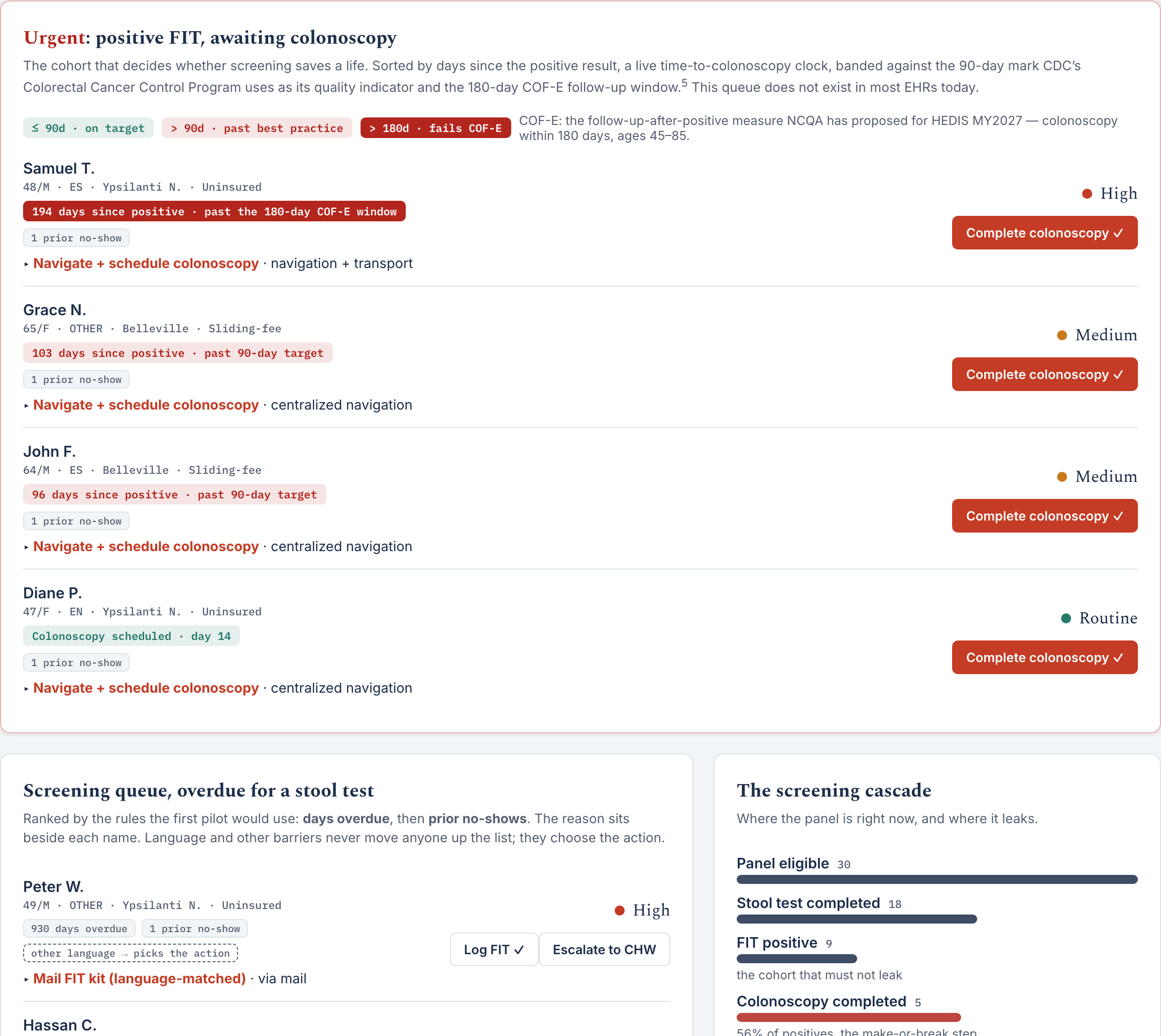
This week: 12 overdue for a stool test, 4 positive tests without a finished colonoscopy. Synthetic panel of 30.
Three transparent rules, shown beside every name: days overdue, days since a positive test, prior no-shows. No predictive model in the first pilot.
WhoThe rules, in the worklist. Anyone on staff can see why a case is where it is.
Samuel T. · 194 days since a positive test · 1 prior no-show → first in the follow-up queue.
Match the action to the barrier: a mailed kit, a reminder in the patient’s language, help booking, or a community health worker.
WhoYour outreach staff, with scripts I write and test with them.
Samuel T. · transport barrier → navigation, plus a ride to the colonoscopy.
Record the completed test or colonoscopy and the days it took, then check whether follow-up differs between language groups.
WhoYour staff record it. I review the week with your quality-improvement lead.
Follow-up by language: English 3 of 4 · Spanish 1 of 3 · Other 1 of 2.
At-home test kits by mail, simple scheduling, and help with whatever is in the way.
From one nightly coded file, I build the weekly list your staff work from. Deeper EHR integration can come later.
So the site’s own staff can run the routine, and keep running it after the pilot.
 See the worklist
The weekly list I would build from your nightly file and go through with your outreach staff. It supports the routine; the calls and kits are done by people. Thirty invented patients: pick a case, record it as done, and watch the numbers move. No real data, and nothing is sent.
Open the worklist →Future capabilities, including any predictive model, come only after a validated pilot. They are set out on the future roadmap.
Twelve months at one Southeast Michigan health center.
Twelve months of running the routine, after a setup period of up to three months for the agreement, the data file and the published plan. The pilot would suit a health center whose colorectal screening rate is below the national health-center benchmark, with a modern EHR, staff who already do patient outreach, and someone who leads quality improvement. I would reach that clinic through the Michigan Primary Care Association and EMU faculty.
A clinic can choose one of five other gaps as its first pilot instead: the blood pressure recheck, the diabetic eye exam, the diabetic kidney tests, follow-up after an abnormal mammogram, or follow-up after an abnormal Pap or HPV test. One gap per pilot, with extra setup before month one. The five finish lines, with their published gaps →
Three months shows whether the routine can run: kits sent and returned, positive tests navigated and booked, days from a positive test to a booked colonoscopy, staff hours used, and whether the nightly file arrives complete. It cannot show that screening rates rose; that is what months 4 to 12 are for. Milestone timing is proposed. The evaluation milestones assume an academic partner joins before month one, and the protocol is agreed with them.
Twenty hours a week to start, thirty from month four. What fills them changes.
I start by doing the work beside your staff, move to teaching it, and end by stepping back. Proposed; the detail is set with your team at the start.
- Before month 1 · setupLearning your clinic
- Sit with the outreach staff and the quality-improvement lead to map how a kit goes out and comes back today.
- Agree the 19 columns of the nightly file with your IT lead.
- Draft the first scripts and letters.
- The evaluator publishes the plan.
- Months 1–3 · feasibilityDoing
- About twenty hours a week. Load the file and refresh the list each Monday.
- Sit in on calls with your outreach staff, and work out why each person has not finished.
- Write and test scripts; change the ones that do not land.
- Report to your QI lead weekly. Month 3: we review the feasibility measures and decide together.
Most hours with staffA few on the file - Months 4–9 · full pilotTeaching
- Your staff run the weekly huddle; I coach rather than lead it, on site once a month and by video in between.
- Train a second person to load the file and keep the list.
- Finish scripts in your patients’ languages, with the staff who use them.
- Month 6: first readout with the evaluator, and we fix what it shows.
Hard cases and trainingRoutine now with staff - Months 10–12 · handoverStepping back
- Your staff load the file, run the list and the huddle. I watch and fix.
- The routine is written down and handed over.
- Month 12: final evaluation, published whichever way it goes.
- By month twelve your staff run it without me.
Watching and fixingStaff run it
Two hours, remote. Nightly file in, refresh the list. Who is new, who is still waiting.
A full day. On site every other week; by video and phone in between. Thirty minutes with your QI lead, then calls beside the outreach staff.
Three hours, remote. Note why people stalled. Rewrite the script that did not work.
Half a day, remote. Chase the positive tests that still have no booking, with whoever has the list.
Two hours, remote. Count what moved and what did not. Short note to the QI lead.
The first two weeks are mostly on site. From month four, on site once a month.
Delivers care
Existing outreach staff make the calls, mail the kits and navigate patients. A quality-improvement lead meets weekly. The site covers kits, postage and texts, and contracts me from month one.
Designs and runs the routine with them
About twenty hours a week in the feasibility phase, thirty from month four. Works the list with staff, matches each follow-up to the reason it stalled, writes and tests the scripts, trains, and fixes what is not working. The data and dashboard are the smallest part. Contracted by the host clinic from month one.
Judges whether it worked
Before and after against the site’s own trend, with a comparison clinic where possible, using RE-AIM. The plan is published first, and the results whichever way they go.
What a host site signs up for
- Cost to your site
- Your clinic contracts me directly, from month one. Months 1 to 3 are a feasibility phase at a reduced rate; from month four, if you continue, the full rate. Both are agreed in writing before month one, and the money can come from your own budget, a Medicaid plan’s quality-incentive dollars, or a grant your clinic holds. As a planning range: about $8,000 to $10,000 for my time in months 1 to 3, and about $45,000 to $60,000 for months 4 to 12 if you continue; the exact figures depend on the hours we agree. Your side is also staff time, kits, postage, texts, and the rides and interpreters you already provide; published mailed-kit outreach runs about $55 in direct cost per patient screened (Pignone et al., 2021, 2019 dollars).
- My time
- About twenty hours a week in the feasibility phase, on site or remote. About thirty hours a week from month four, through month twelve, if you continue.
- What I do each week
- Most of the week is spent with your team. With your outreach staff I go through the priority list and work out, from what they hear on the calls, why each person has not finished: cost, fear of the procedure, the bowel prep, transport, time off work, or a reminder that never made sense to them. Then we pick the next step that fits that reason. I write and test the reminder scripts and letters in plain language (and in patients’ own languages where needed), train staff to use them, and change the routine with your quality-improvement lead when a step is not working. Loading the nightly file and keeping the list and dashboard current takes a few hours a week.
- What your staff do
- Make the calls, mail the kits and navigate patients, in your own systems, with staff time we size together at baseline. No new hires.
- At month three
- We review the feasibility measures together. If they are met, you decide whether to continue to month twelve. If not, we stop. Nothing continues by default.
- What stays with you
- Patient contact, clinical decisions, the key that links codes to patients, and the outreach budget for kits, postage and texts.
- If it does not work
- The site goes back to how it worked before, and the plan and the negative result are published. Your clinic is not named in anything published unless it chooses to be.
- If I cannot continue
- The routine is written down as it is built: the list rules, the scripts, the file specification and the weekly huddle. If I become unable to continue, your staff keep running it with what has already been handed over, payment for my time stops, and the evaluator still reports what happened. The written agreement sets this out before month one.
The data spec is the whole ask of your IT team: 19 coded columns in one nightly file, with dates sent as day counts. No name, MRN, full date of birth, address or phone leaves your system, and the key stays with you. Field-by-field notes are in the worklist demo.
This page is versioned. This version is dated ; earlier versions are archived as dated copies. A dated PDF of this version, with every tab and question expanded: initiative page, 23 October 2026 (PDF), archived on Zenodo as doi:10.5281/zenodo.23589330. All versions: doi:10.5281/zenodo.23589329.
The work already done.
Judge the initiative by what exists before the ask.
Screening volume inside a real delivery system
At Praava Health in Bangladesh, as Head of Marketing & Corporate Sales, I redesigned the diagnostic packages and launched Ghore Lab, a home sample-collection service, during COVID. Laboratory screening utilization rose 34% from 2021 to 2022. That was volume and follow-through, not screening completion; the pilot measures completion.
A published record
An MPH capstone (Eastern Michigan University) examining health-system fragility and prevention across the U.S. and Bangladesh, published publicly as Season 1’s nine-article argument.
Attention on a $0 budget
Season 1’s advocacy campaign drew 57,274 impressions, summed across three platforms and reconciled to better than 94%, with no ad spend, 5.7× the target set in advance.
The routine, before the ask
The weekly routine, its pillars, the evaluation approach, the worklist demo and the U.S. brief are designed and public. Nothing is deployed.
The hard part of this pilot is getting people to finish the test.
The work in this pilot draws on three kinds of skill that clinics usually get from different people: someone who can explain a test so people act on it, someone who knows why people drop out of a service halfway, and someone who can make a weekly routine stick in a busy clinic. I have worked in all three.
Messages people act on
MPH in Health Education & Promotion (Eastern Michigan University) and CHES®. Reminders, letters and call scripts written at the right reading level, and staff trained to use them.
Seventeen years getting people to follow through
Marketing and growth work, as a Member of the Chartered Institute of Marketing (MCIM), in health care since 2021. At Praava Health in Bangladesh I led the diagnostic-package redesign and the Ghore Lab launch behind the 34% above. During the pandemic, Praava served about 2% of Bangladesh’s population, about 3.6 million people, and about 8% of Dhaka’s. Part of the work was patient education on which tests people need, so they could test without going through the physician referral commissions common in that market (my own account of the case). Many of the reasons people dropped out there (a price surprise at the next step, urgency that never landed, a second visit that was hard to make) show up in colorectal follow-up too.
A routine that keeps running
MBA in operations management, and chief operating officer at Laser Treat Group, where I ran the company’s ERP, BI and CRM systems. The worklist demo on this site is HSREP’s own build.
Md Shafaat Ali Choyon, Founder, HSREP · MBA, MCIM, MPH, CHES®. Your staff know your patients and your community. I know why people stop halfway through a service and what gets them to finish, from seventeen years of getting people to follow through, in health care since 2021. Put together, that is how the routine gets built, and an independent evaluator, once confirmed, judges the result.
A pilot proposed from a published, measured argument.
This page is the third step of a thread that began with an article. Each step is public and dated.
- Argued
When we ignore public health prevention, we pay the price
The Eastern Echo · 14 Nov 2025
- Measured
Season 1: nine pieces, two countries
57,274 impressions (post appearances, not people), $0 paid · 21 Feb – 12 Apr 2026
- Proposed this page
Prevention Adoption Initiative
Published July 2026 with a working worklist demo · in development
- Asked practitioners
Roundtable № 02: where does preventive care break down?
Open since 9 Sep 2026 · moderated, on the record
- Next
Colorectal Cancer Screening Completion Pilot
One host clinic sought · 12 months · decision at month three
- Then
The same routine, five other completion gaps
Roadmap, or a clinic’s first choice · blood pressure, diabetic eye exam, kidney test, two follow-ups
Sources, limits and plain answers.
Sources and methods
The Community Preventive Services Task Force recommends each method, with these median effects on colorectal cancer screening:
| Method | Median increase, percentage points | Pillar |
|---|---|---|
| Reducing structural barriers (mailed at-home kit) | +16.1 | Make finishing easy |
| Provider reminder and recall | +15.3 | Know who is overdue |
| Patient navigation | +13.6 | Train the site’s staff |
| Patient reminders | +11.5 standalone, +10.9 incremental | Know who is overdue |
These are published effects in other settings, not the pilot’s expected results, and they are not added together. STOP CRC (Coronado et al., JAMA Internal Medicine 2018) is the cluster-randomized trial in 26 health centers behind the −7 to +18 point range.
Sources: CDC Community Preventive Services Task Force, colorectal cancer screening findings, accessed 3 August 2026; Borsky et al., Health Affairs 2018; Healthy People 2030 objective C-07 (2023 baseline 63.5%, target 72.8%); HRSA Uniform Data System CY2025 national and Michigan performance indicators, accessed 3 August 2026. UDS changed its screening age range from 50–75 to 45–75 beginning CY2023, so years before and after that change are not directly comparable.
How patient data would be handled
The host site remains the covered entity and keeps the key that links codes to patients. The coded nightly file never leaves the host site’s systems. It lands in a restricted folder on the site’s own secure storage, and I work in it through an account the site issues, under the site’s privacy policies. Nothing is copied to HSREP, and the site switches off that access when the pilot ends. The academic partner, once one is confirmed, receives a separate de-identified extract for the evaluation, under its own agreement with the site and its IRB’s review. Whether that file, and HSREP’s work beside clinic staff, needs a business associate agreement, a limited data set or another arrangement is for the host’s privacy officer and counsel to determine. That determination comes before launch, not after.
Consent and outreach run under the site’s own policies. Operational materials will be reviewed by counsel before any launch.
What is the Prevention Adoption Gap?
Why track follow-up colonoscopy, not just the screening test?
Is the colorectal-cancer screening pilot running yet?
Where would the first pilot run?
Is the initiative specific to colorectal cancer?
Can our clinic pilot a different gap, such as diabetes or blood pressure?
How can an organization host or partner on the pilot?
Who pays for the pilot?
Can the pilot start without an academic partner?
What would an evaluator need from the site?
Does the first pilot use AI?
How is this different from CDC's Colorectal Cancer Control Program?
What is the Prevention Adoption Initiative?
If your organization owns preventive-care completion, let’s talk.
Host the pilot, fund it, or partner on it. Step one is a 30-minute conversation.
Where does preventive care break down between recommended and completed in your setting?
The Prevention Adoption Gap is the argument on this page. The open question is the same argument put back to the people who watch it happen: colorectal screening reaches 44.89% at the average federally qualified health centre and 48.74% in Michigan, and the reasons are not in the published figures.
Answer from your own setting. Five minutes, under your name and affiliation, read before anything is published, and nothing published without your consent.