Mixed messages, real costs: how confusing health communication is making America sicker and poorer
What happens when the information environment itself becomes a public health risk.

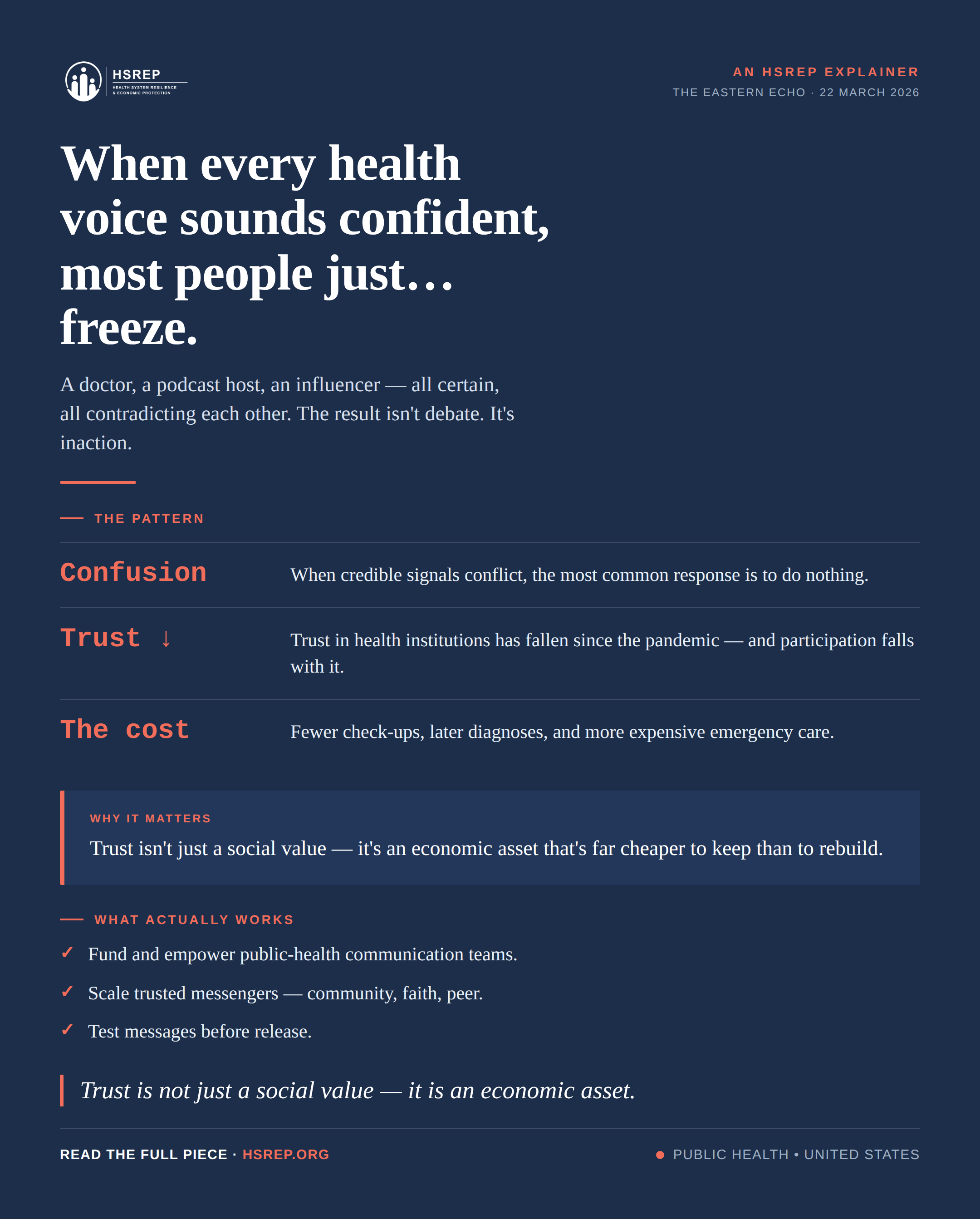
- America doesn’t have a shortage of health information. It has a coherence crisis: institutions, influencers, and media sell competing versions of truth, and the confused patient does nothing.
- Conflicting information measurably reduces willingness to follow evidence-based recommendations; confusion produces paralysis, and paralysis is expensive, later detection, more emergency care.
- Public health agencies were built for a media environment that no longer exists; credibility today is relational, tested messages and trusted messengers, not institutional authority alone.
- Health communication is essential infrastructure: every dollar in consistent, culturally competent messaging prevents far costlier crises downstream.
Imagine scrolling through your phone to answer a simple question: Should I get the latest booster?
Your doctor says yes. A podcast host with millions of listeners says the science is still unsettled. A cable news segment warns about risks. A wellness influencer recommends elderberry syrup instead. Each voice is confident, polished and designed to feel trustworthy. You do not have the time or training to sort through the noise. So you do what many overwhelmed people do. You do nothing.
This is not about one vaccine, one diet or one health controversy. It is about what happens when the information environment itself becomes a public health risk.
In marketing, a confused consumer does not buy. In health, a confused patient does not act. When people receive conflicting messages about what to eat, whether to vaccinate or how to manage a chronic condition, the most common response is inaction. Behavioral research shows that when options multiply and signals of credibility conflict, decision-making breaks down. People default to whoever sounds most confident, follow what their social circle endorses or disengage altogether.
The coherence crisis
America doesn't have a shortage of health information. It has a coherence crisis.
When institutions can't keep pace, media rewards provocation, and influencers monetize confusion, the public pays with its health and its wallet.
Today, health information functions like a marketplace. Government agencies, pharmaceutical companies, media personalities, influencers and supplement brands all compete for attention. Institutions rely on scientific authority and careful language. Influencers rely on personal stories, emotional appeal and distrust of the system. These are not just different messages; they are different versions of truth competing for the same outcome: whether people take preventive action.
The costs of this confusion are not abstract. National polling shows that public trust in major health institutions has declined since the pandemic, alongside increased uncertainty about vaccines, screenings and preventive guidance. When trust erodes, participation drops. Fewer people show up for routine care. Conditions are detected later. Emergency care becomes more common and more expensive.
Research consistently finds that exposure to conflicting health information reduces people's willingness to follow evidence-based recommendations, especially among those already uncertain about the medical system. Confusion does not create healthy skepticism; it creates paralysis. And paralysis is costly.
Trust, in this sense, is not just a social value. It is an economic asset. Public health depends on cooperation: people agreeing to vaccination schedules, reporting symptoms, participating in screening programs and sharing accurate information. When confidence collapses, rebuilding it requires far more resources than maintaining it would have cost in the first place.
In marketing, a confused consumer does not buy. In health, a confused patient does not act.
The problem is structural. Public health agencies were built for a media environment that no longer exists, one where press briefings and local newspapers could deliver consistent messages to most households. That infrastructure is gone. Today's information economy rewards speed, outrage and emotional certainty, while institutions are constrained by review processes and risk aversion. In that gap, louder and less accountable voices thrive.
Health policy scholars have argued that public health must now adopt modern strategic communication tools not as a marketing gimmick, but as a survival strategy. That means understanding audiences, testing messages before release and working through trusted messengers rather than assuming institutional authority alone is enough. Credibility today is relational, not automatic.
At the local level, the consequences are immediate. In communities like Ypsilanti, where students and families juggle tuition, rent and multiple jobs, confusing health guidance has real effects. Unclear flu-vaccine messaging means more illness during exam season. Contradictory nutrition advice pushes families toward whatever advice sounds cheapest or easiest online. Campus and community health teams work hard to cut through the noise, but they face the same staffing and funding limits as public health departments nationwide.
This is not an argument for censorship or a single centralized voice. It is an argument for treating health communication as essential infrastructure. Public agencies need funded, empowered communication teams that can respond quickly and clearly. Trusted messenger networks, including community leaders, faith leaders and peer educators, must be scaled. And the economic case must be stated plainly: every dollar invested in consistent, culturally competent health messaging prevents far more expensive crises downstream.
America does not have a shortage of health information. It has a coherence crisis. When institutions cannot keep pace, media rewards provocation and influencers monetize confusion, the public pays with its health and its wallet.
The question is not whether we can afford to invest in better health communication. It is whether we can afford not to.