We need public health reform for steady economic growth
In Bangladesh, investing in public health isn't just a moral obligation, it's an economic requirement.

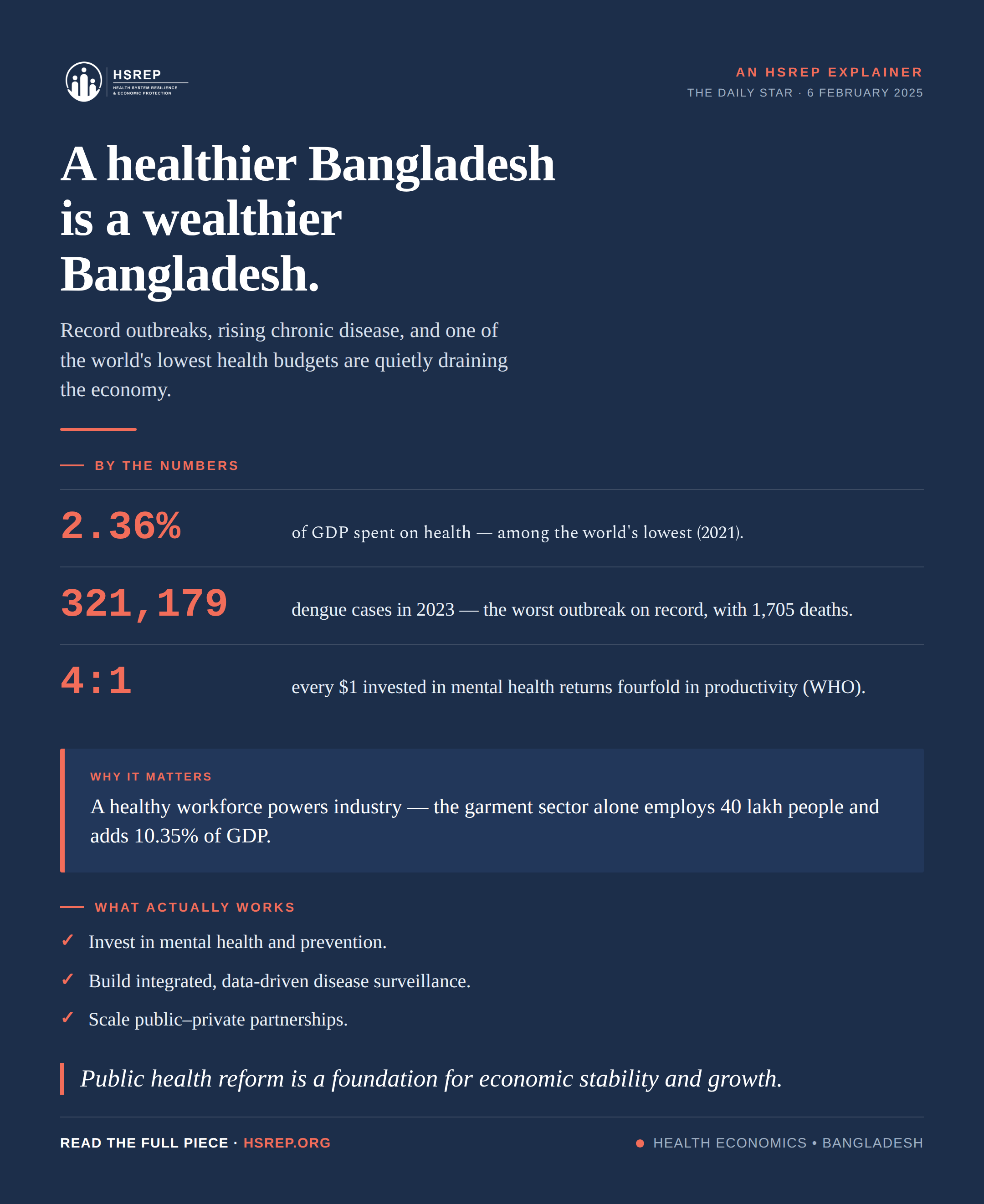
- For Bangladesh, public health investment is an economic requirement: a record dengue year (321,179 cases, 1,705 deaths in 2023), a double disease burden, and among the world’s lowest public health spending.
- The returns are measurable: WHO estimates a fourfold productivity return on every dollar invested in mental health.
- Data is the multiplier: Singapore-style outbreak prediction, expanded DGHS real-time reporting, and public-private analytics for TB, AMR, and seasonal disease.
- A healthier workforce sustains growth, the RMG sector (4 million+ workers, 10.35% of GDP) shows the stakes. Public health reform is a foundation for economic stability.
In Bangladesh, where financial pressures and public health issues meet, investing in public health is not just a moral obligation, it is an economic requirement. By concentrating on harm mitigation approaches and employing health policies informed by data, the country can achieve economic steadiness in the short run, develop resilience in the medium range, and guarantee long-lasting growth.
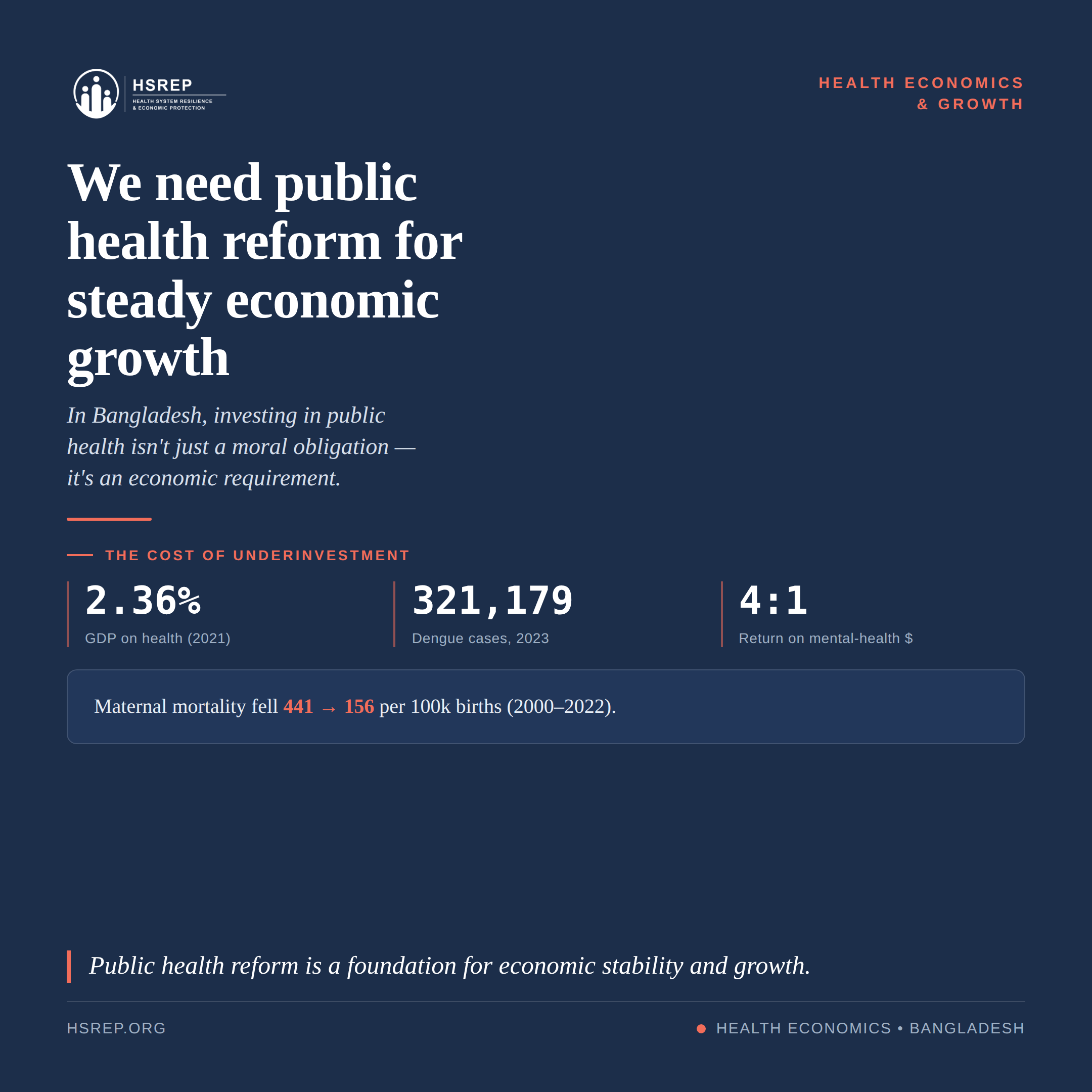
The need for such investments is urgent. In 2023, Bangladesh faced its worst dengue outbreak on record, with 321,179 cases and 1,705 deaths. The double burden of infectious and non-infectious diseases (NCDs) continues to put pressure on the healthcare system, worsened by one of the lowest health spending by a government in the world: 2.36 percent of GDP in 2021. Expanding public health programmes is not just about saving lives, it's about promoting economic strength.
Harm reduction tactics play a vital part in stabilising economies during health emergencies by maintaining workforce efficiency and lowering healthcare expenses. In Bangladesh, mental health concerns made worse by socioeconomic stresses brings to focus the urgent need for specific actions. Stress and worry suffered by informal workers, along with high out-of-pocket health costs, diminish productivity and burden households.
During winter, health complications like breathing troubles and stomach ailments significantly affect vulnerable populations, especially kids and older adults. Tuberculosis (TB) also remains a continual issue, with Bangladesh ranking among the top eight countries globally for TB burden in 2022. Tackling these immediate health problems through focused harm-reduction efforts is essential to lessen economic disturbances.
As per the World Health Organization (WHO), every dollar directed towards mental health produces a return in efficiency that is fourfold. Enhancing mental health resources along with disease prevention programmes ensures short-term stability while creating a base for future strength.
The cost of underinvestment
Big data provides changing possibilities for tackling both temporary and long-term health issues. Singapore's National Environment Agency (NEA) taps into data to foresee dengue outbreak areas by scrutinising weather conditions, mosquito breeding details, and infection trends. Bangladesh can imitate this method to handle its ongoing health emergencies more efficiently.
In response to the Covid-19 pandemic, the Directorate General of Health Services (DGHS) pointed to the fundamental value of having centralised data. Real-time reporting enable effective resource distribution, such as assigning treatment centres and prioritising vaccine distributions in areas with high demand. Expanding this system through collaborations with private healthcare providers could build an integrated analytics platform capable of tracking diseases like TB, antimicrobial resistance (AMR), and seasonal ailments.
Working together with healthcare-providing businesses would boost disease monitoring and management. Public-private partnerships could also improve oversight of environmental health dangers, such as unsafe food and waterborne illnesses, which mainly impact underprivileged communities.
Preventive healthcare is essential as a mid-term solution. Non-communicable diseases, which made up 14 of the top 20 reasons for death in 2019, are a rising worry in Bangladesh. Issues like high blood pressure and diabetes have grown considerably.
Increasing access to health check-ups and preventive programmes can help tackle these challenges. For instance, predictive analysis can spot high-risk groups, making sure resources are aimed at areas of greatest necessity. Programmes designed for neglected rural areas could also help close gaps in health results, creating a healthier and more efficient workforce.
Bangladesh has accomplished notable progress in maternal and child health. Between 2000 and 2022, maternal mortality rates decreased from 441 to 156 for every 100,000 live births. Building on this achievement by tackling newborn issues and poor nutrition, both major factors in disability-adjusted life years (DALYs), can secure long-term health improvements.
Public health reform is not just a necessity; it is a foundation for economic stability and growth.
In the long run, public health spending brings significant economic rewards by building a healthier workforce. Bangladesh's ready-made garment (RMG) industry, which hires over 40 lakh people and adds 10.35 percent to GDP, illustrates this potential. Yet, issues with breathing difficulties and continuous strain injuries are widespread in the workforce, contributing to absentee workers and lesser output levels.
Working with various healthcare organisations to offer regular health check-ups for workers would improve well-being and boost productivity. A stronger workforce strengthens industries, attracts foreign investment, and supports economic stability.
New technologies, like blockchain and machine learning, could greatly transform public health systems. Blockchain ensures safe, clear data storage, while machine learning finds patterns and predicts new risks. Estonia's blockchain-based healthcare system shows how these tools improve data reliability and enhance outcomes. For Bangladesh, using similar innovations would ensure a strong health system capable of supporting sustainable growth.
Bangladesh's life expectancy has risen from 58.2 years in 1990 to 74.6 years in 2019, a significant improvement in public health. However, the country's healthcare challenges from rising non-communicable diseases to occasional outbreaks require immediate attention. Spending on public health creates a positive cycle: a healthy population boosts productivity, and a thriving economy supports better health outcomes.
By taking action now boosting mental health support, adopting comprehensive data systems, and building public-private partnerships, Bangladesh can ensure a healthier, stronger future. Public health reform is not just a necessity; it is a foundation for economic stability and growth.
Corrections & clarifications
- The article describes 2.36 percent of GDP as health spending “by a government.” That figure is Bangladesh’s total health expenditure for 2021, public and private combined, as reported in the WHO Global Health Expenditure Database. Domestic general government health expenditure is well under one percent of GDP, which makes the article’s underlying point stronger, not weaker.
This piece is reproduced as it was originally published. Where a figure or an attribution needs correcting, HSREP records the correction here rather than editing the published text. Each dated note above links to its entry in the HSREP corrections log.