When the Ground Shakes, Neighbors Respond First
Why community-based earthquake preparedness is Dhaka’s most urgent and affordable defense.

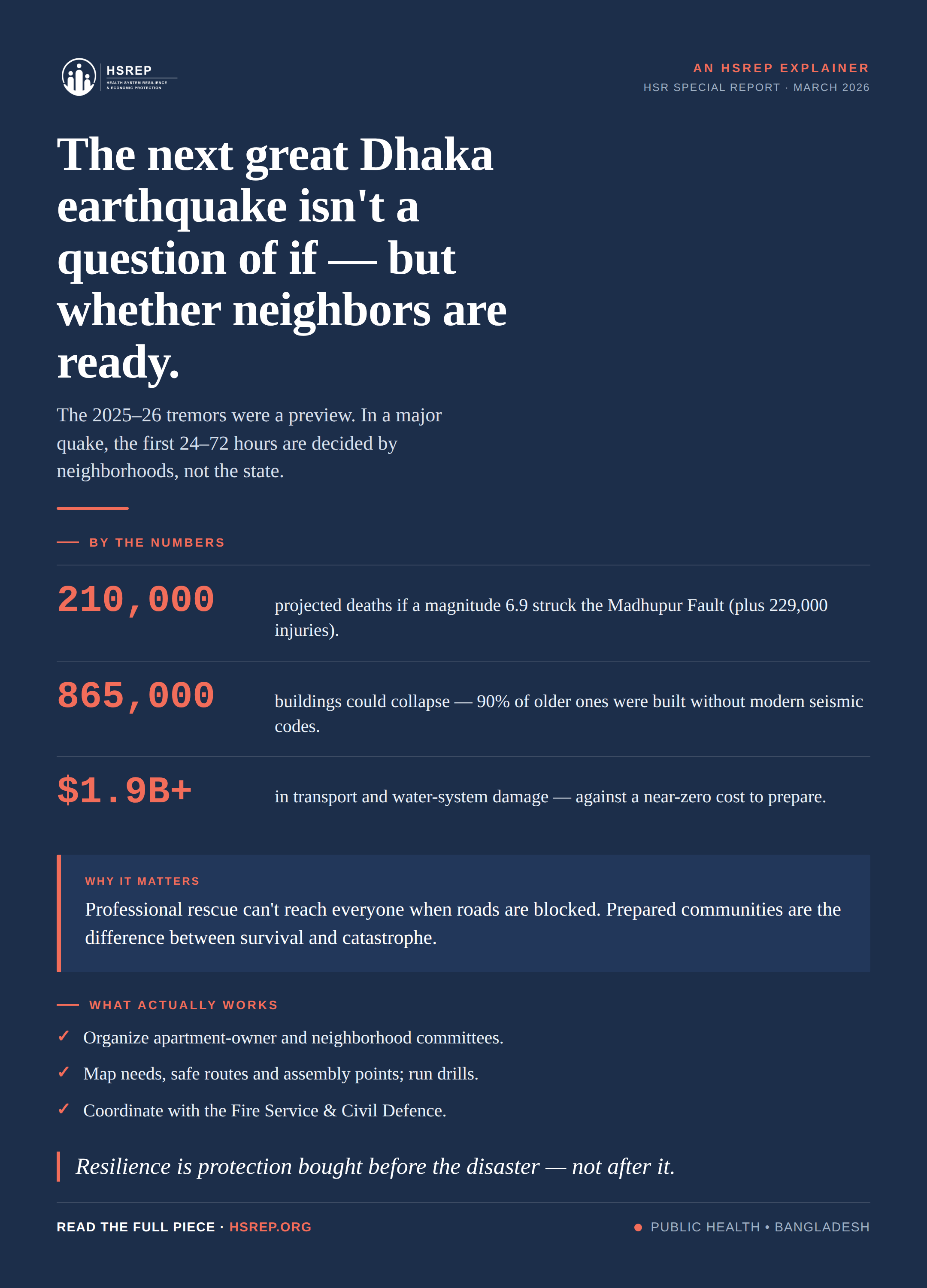
- The magnitude-5.4 quake near Dhaka in November 2025, and 38 tremors since, are a preview of a projected magnitude 6.9-7.0+ event the city is unprepared for; most older buildings ignore seismic codes and Dhaka’s soft soil amplifies the shaking.
- Government measures (100,000 volunteers, early-warning systems, drills) are necessary but cannot reach everyone in the critical first 24-72 hours. The survival window is decided at the neighborhood level.
- The most effective, lowest-cost defense is community organization: apartment and neighborhood committees running needs assessments, evacuation routes, and regular drills, an approach the Red Crescent has already proven.
- The economics are decisive: a major quake means billions in damage while community drills cost almost nothing. Resilience is protection bought before the disaster, not after.
On November 21, 2025, a magnitude 5.4 earthquake struck barely 25 kilometers from central Dhaka, killing 10 people and injuring over 600. The shaking lasted 26 seconds. For many of Dhaka’s 36.6 million residents, those seconds compressed a lifetime of ignored warnings into a single, terrifying moment. Buildings cracked, power stations shut down, and students leapt from upper-story windows in panic. The event was the deadliest earthquake to hit Bangladesh in over two decades, and seismologists are clear that it was not the main event. It was a preview.
Since then, the tremors have not stopped. Over the 14 months leading up to early 2026, at least 38 earthquakes originated within Bangladesh or along its borders, spanning 15 districts. A magnitude 5.3-5.5 tremor struck the Khulna Division near Satkhira in February 2026, an area previously considered low-risk. Reporting in late 2025 described a roughly 400-kilometer structural trend running from the Mymensingh-Jamalpur area toward Kolkata, broadly following the long-recognized Calcutta-Pabna-Mymensingh Hinge Zone. That characterization has not yet appeared in peer-reviewed literature, but it has added further urgency to the public conversation. The ground beneath Bangladesh is shifting in ways that demand immediate, practical responses at every level of society.
The Scale of the Threat
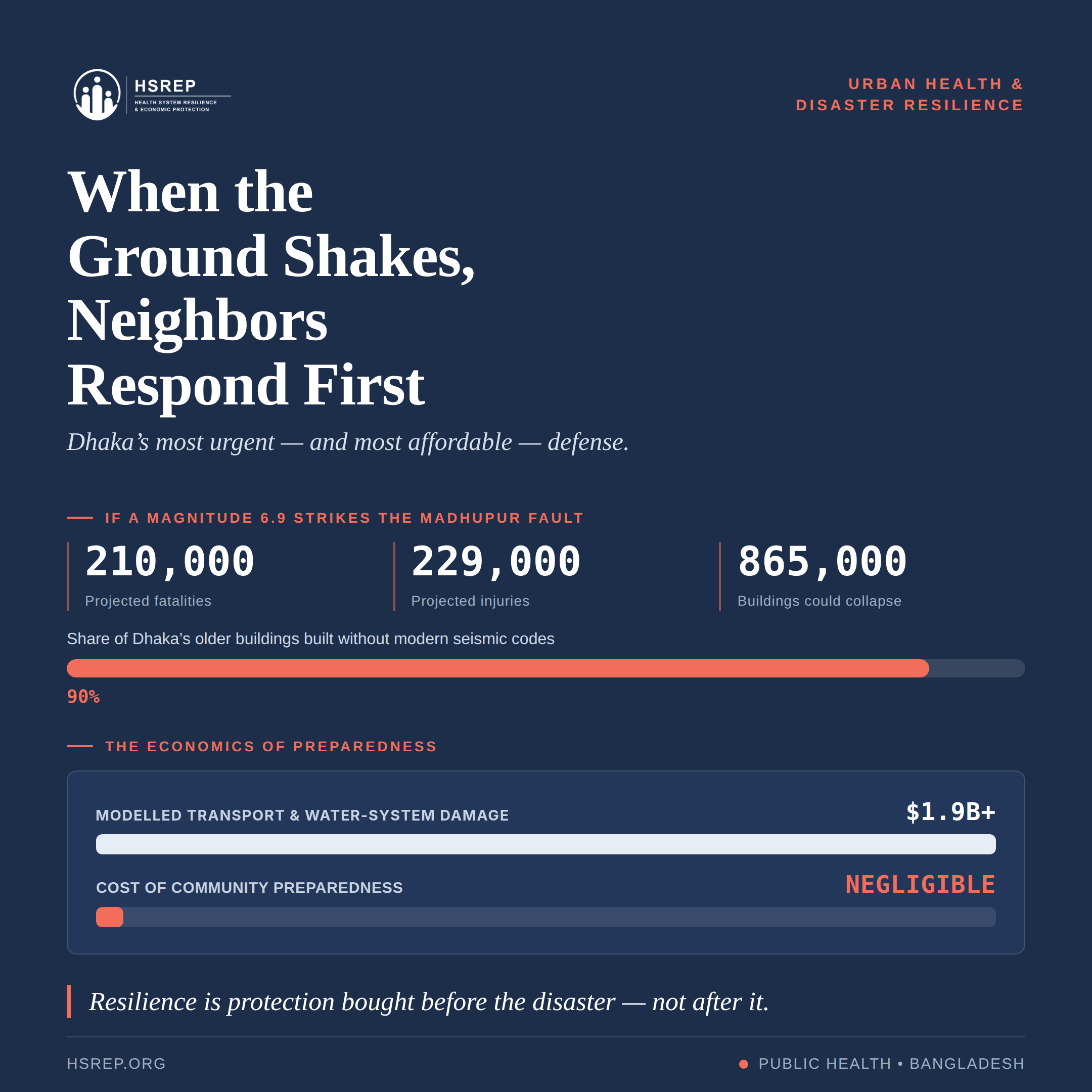
Bangladesh sits at the collision zone of the Indian, Eurasian, and Burma tectonic plates. Tectonic stress has been accumulating along the Sylhet-to-Teknaf megathrust fault for nearly a millennium. Engineers at BUET have repeatedly warned that a magnitude 7.0-plus earthquake could cause widespread structural collapse in Dhaka, where the vast majority of older buildings were constructed without adherence to modern seismic codes. RAJUK’s own modeling of a magnitude 6.9 event on the Madhupur Fault projects a human and structural toll on a scale the city has never planned for.
RAJUK projection · magnitude 6.9 on the Madhupur Fault
Compounding the structural fragility is Dhaka’s geology. The city rests on thick, water-saturated alluvial sediments of the Bengal Basin. During a tremor, this soft soil amplifies seismic waves, a phenomenon scientists call the “jelly effect”, causing prolonged swaying in high-rise buildings and raising the severe risk of soil liquefaction. In a megacity with population density reaching 30,000 people per square kilometer and roads too narrow for rescue vehicles, the mathematics of a major earthquake is catastrophic.
In the crucial hours following an earthquake, prepared communities are often the difference between survival and catastrophe.
Government Action: Necessary but Insufficient
In March 2026, Prime Minister Tarique Rahman directed the mobilization of 100,000 volunteers in Dhaka for earthquake response, modeled on the coastal cyclone preparedness program. The Ministry of Disaster Management and Relief has conducted National Earthquake Simulation Exercises with the UN WFP. Bangladesh launched a National Roadmap for Multi-Hazard Early Warning Systems, targeting full citizen coverage by 2027. On March 10, 2026, the Fire Service and Civil Defence held large-scale mock drills at Sher-e-Bangla Agricultural University.
These are important steps. But government-led initiatives face a fundamental constraint: in a major urban earthquake, professional rescue services simply cannot reach everyone. Roads will be blocked by debris. Communication networks will fail. The critical survival window, the first 24 to 72 hours, will be defined not by the capacity of the state, but by the preparedness of neighborhoods.
The Community-Level Solution
Apartment owner associations and neighborhood committees are uniquely positioned to organize the first operational layer of disaster response. The framework is straightforward and requires minimal financial investment. Communities conduct a simple needs-gap assessment: mapping age distribution, identifying households requiring special evacuation assistance, cataloging residents with medical training or expertise, and understanding daily occupancy patterns.
Communities identify safe evacuation routes and assembly points, school playgrounds, public parks, open parking areas, and practice reaching them through periodic drills. They coordinate with the Fire Service and Civil Defence for realistic training and post-drill evaluations. Organizations like the Bangladesh Red Crescent Society, through its DEEPER project, have already demonstrated that community-level training produces measurable preparedness gains.
The Cost of Inaction
Experts estimate that a major Dhaka earthquake could cause billions of dollars in damage to transport networks and basic water infrastructure alone. Against these figures, the cost of community drills, resident training, volunteer coordination, printed safety guidelines, and occasional training sessions, is negligible. The return on investment, measured in lives saved during the critical hours before professional rescue arrives, is incalculable.
The economics of preparedness
Resilience is protection bought before the disaster, not after it.
Bangladesh’s cyclone preparedness transformation, from Bhola’s hundreds of thousands of deaths in 1970 to dramatically reduced fatalities in recent decades, proves that community-based disaster response works when sustained over time. The earthquake challenge demands the same commitment. The tremors of 2025 and 2026 are warnings delivered without mass tragedy, a gift that geological history rarely offers twice. The question is not whether the next major earthquake will come, but whether Dhaka’s communities will be organized when it does.
Corrections & clarifications
- The article labels $1.9 billion as the cost of inaction from one major Dhaka earthquake. The arithmetic holds. The label does not. The figure is the sum of two components: more than $1 billion in transport-sector losses and $887 million in water and wastewater damage. It covers lifeline infrastructure only, and excludes buildings, health facilities and wider economic disruption. The stat card, the accessibility description, the FAQ answer and the social card now state what the number covers and what it leaves out.
- The article describes a newly identified 400-kilometer fault line. That characterization has not appeared in peer-reviewed literature. What was reported in late 2025 is a roughly 400-kilometer structural trend running from the Mymensingh-Jamalpur area toward Kolkata, broadly following the long-recognized Calcutta-Pabna-Mymensingh Hinge Zone. The page now describes it that way, and says plainly that it is not yet in the literature.
This piece is reproduced as it was originally published. Where a figure or an attribution needs correcting, HSREP records the correction here rather than editing the published text. Each dated note above links to its entry in the HSREP corrections log.