When we ignore public health prevention, we pay the price
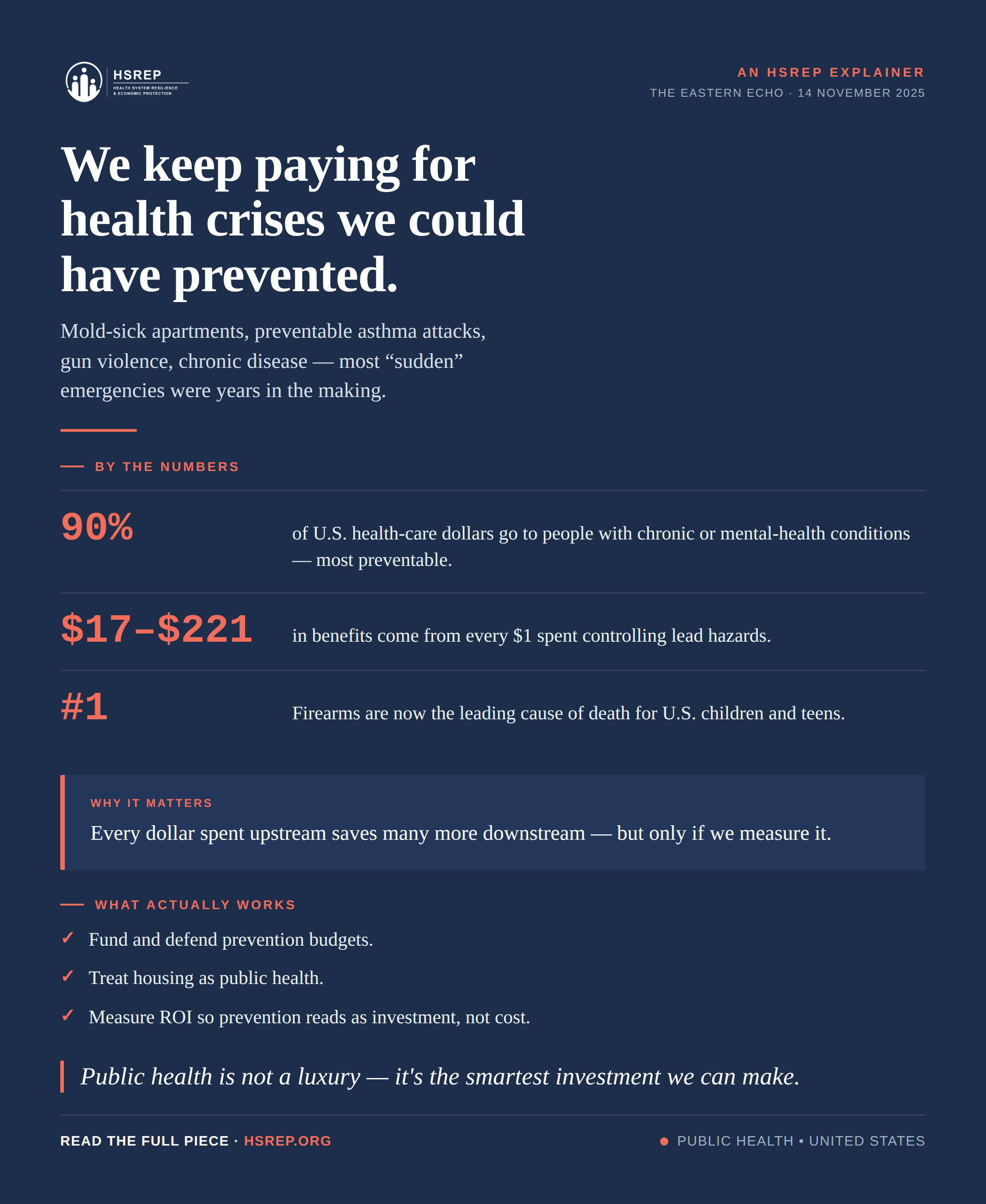
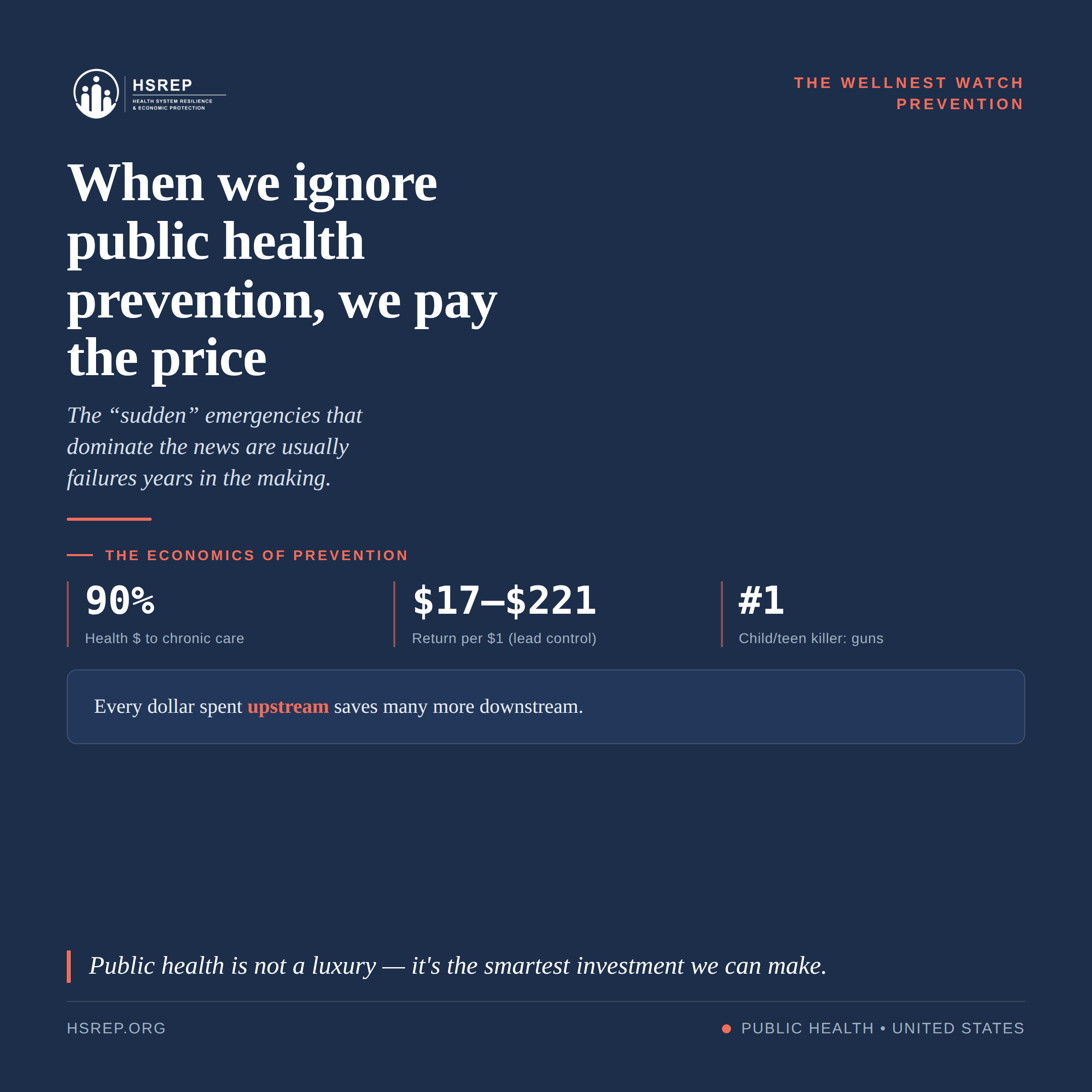
The “sudden” emergencies that dominate the news are usually failures years in the making.

- The emergencies that dominate headlines (shootings, mold-sickened housing, preventable asthma attacks) are usually failures years in the making: prevention rides in the backseat while emergency care takes the wheel.
- The returns are documented: every $1 in lead-hazard control yields $17–$221; evaluated violence-intervention programs cut shootings by double digits; 90% of U.S. health spending goes to largely preventable chronic and mental-health conditions.
- Program evaluation makes prevention visible: without tracking, prevention looks like a cost; with it, every upstream dollar provably saves more downstream.
- The invisible shield (clean water, safe housing, vaccination, mental-health outreach) needs proof and defended budgets, not just belief.
A school shooting dominates the headlines. An Ypsilanti apartment is closed after mold makes families sick. An Eastern Michigan University student collapses from an asthma attack that could have been prevented.
These moments look like sudden emergencies, but in reality, they are failures from years in the making.
Public health was designed to stop problems before they explode into crises. Yet in America, prevention often rides in the backseat, while the sirens of emergency care take the wheel. That comes with a price, in lives lost, neighborhoods disrupted and ballooning medical bills.
In Ypsilanti, where campus and community overlap, the challenges of aging housing, chronic stress and preventable disease affect students and long-time residents alike. What we call a public health crisis in one part of town often begins with the same overlooked causes in another.
This is where program evaluation matters. The quiet work of tracking outcomes and measuring return on investment proves what prevention can deliver. Without it, prevention looks like a cost instead of an investment. With tracking, we see that every dollar spent upstream saves many more downstream.
Every dollar spent upstream saves lives and money downstream.
In Ypsilanti and across Michigan, aging housing stock is more than an eyesore; it's a health hazard. Damp walls and mold are linked to respiratory infections and asthma exacerbation, according to the U.S. Centers for Disease Control and Prevention and the National Institute for Occupational Safety and Health, which document associations of indoor dampness with new or worsening asthma and respiratory symptoms. Through my work in EMU Housing and Residence Life, I've learned that housing is public health in practice. Living spaces shape behavior, influencing sleep, stress, nutrition and the sense of connection that defines well-being.
Residence halls are more than places to live; they're health environments where supportive, inclusive design can strengthen both individual and community resilience.
Evaluations of housing programs show the economics clearly: every $1 invested in lead hazard control produces $17 to $221 in benefits, from lower healthcare costs to improved lifetime earnings. Prevention here is not just public good; it's fiscal sense.
Firearms are now the leading cause of death for U.S. children and teens, according to the CDC. That fact alone reframes gun violence as not only a criminal justice issue but a public health emergency. Community violence intervention programs, which use credible messengers and trauma-informed care, have shown double-digit drops in shootings when evaluated rigorously. The U.S. Surgeon General declared firearm violence a public health crisis in 2024. Each shooting prevented saves hundreds of thousands in hospital bills, emergency response and lost productivity. Cutting violence upstream means cutting those costs.
Beyond the headlines, chronic diseases like diabetes, hypertension and obesity quietly drain families and strain budgets. The CDC estimates that 90% of U.S. health-care dollars go to people with chronic or mental health conditions. Most of these conditions are preventable with early behavior change: healthier diets, stress management, more movement and timely screenings. Through my consulting with EMU's Office of Health Promotion, I've seen how simple programs, from peer fitness groups to stress-reduction workshops, can shift behaviors and set the stage for lifelong health. Evaluations show that even the modest prevention investments can save billions in national healthcare costs.
The economics of prevention
Every skipped screening or unmanaged case is not just a personal tragedy; it's a collective bill we all pay through higher premiums and lost productivity.
The national picture tells the same story. The United States spends more per person on health care than any other wealthy nation, yet Americans live shorter lives and experience more preventable diseases, according to the Commonwealth Fund and Health System Tracker. When prevention is sidelined, the bill doesn't disappear; it just resurfaces later, multiplied, in hospital costs, insurance premiums and national debt.
At Eastern Michigan University, most students notice public health only when it fails, a lockdown during a threat, an outbreak that cancels class or housing complaints that become emergencies. But the invisible shield of prevention is all around us: clean water, safe housing, vaccination campaigns and mental health outreach. If we want that shield to be strong, we need more than belief; we need proof. That means valuing evaluation, defending prevention budgets and asking our leaders to measure what matters.
We can keep waiting for the next crisis to dominate the news. Or we can put prevention in the driver's seat, using evaluation to show that every dollar spent upstream saves lives and money downstream. Public health is not a luxury; it is the smartest investment we can make in our future.