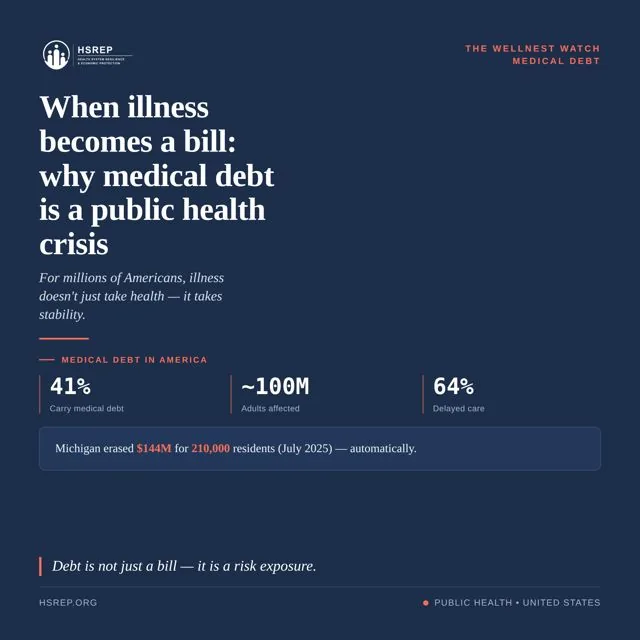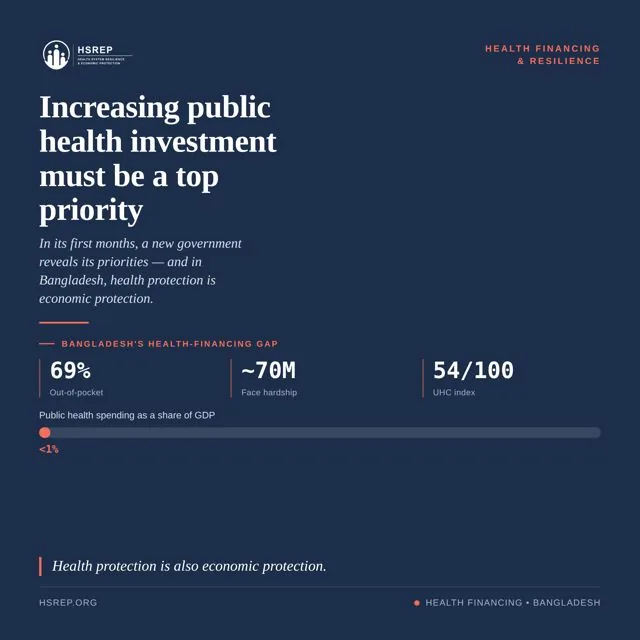

Policy-research & advocacy platform · Independent · Since 2026

Health protection is economic infrastructure not a residual budget line.

HSREP publishes sourced health-system arguments, shows how they travel through professional audiences, and builds practical ways to respond or apply them.

The protection chain
A health shock
An illness, a bill, an outbreak, a disaster.
Household security
Savings, work and schooling hold, or collapse.
Institutional continuity
Clinics, budgets and public services absorb the shock, or fail.
Economic protection
Resilient health systems protect livelihoods, stability and trust.
The thread

From a published argument to a proposed pilot.

HSREP argues in public, measures how the argument travels, proposes something that can be tested, and puts it back to the people who do the work. One thread, dated at every step.

  1. Argued

    When we ignore public health prevention, we pay the price

    The Eastern Echo · 14 Nov 2025

  2. Measured

    Season 1: nine pieces, two countries

    57,274 impressions, $0 paid · 21 Feb – 12 Apr 2026

  3. Proposed

    Prevention Adoption Initiative

    Published July 2026 with a working worklist demo · in development, nothing deployed

  4. Put to peers

    Roundtable № 02: where does preventive care break down?

    Open since 9 Sep 2026 · moderated, on the record

  5. Then

    The same routine, five other completion gaps

    Roadmap, not scheduled · blood pressure, diabetic eye exam, kidney test, two follow-ups

Every step is dated and links to the record. The initiative is proposed, not running: an HSREP initiative in development.How HSREP works →
Open now · three questions · no closing date

Where does preventive care break down between recommended and completed in your setting?

Three questions are open. Answer the one your own work speaks to: five minutes, under your name, moderated, and published.

Add your response →
§ 01 · Season 1 · The published record

The published record.

Every claim carries its source; every metric, its methodology.
Platform-reported distribution
57,274
Views + impressions · three platforms · eight weeks
Published pieces
9
6 outlet chapters · 1 special report · 2 foundations
Paid promotion
$0
Fully organic distribution
Campaign benchmark
5.7×
Against the pre-set 10,000-exposure criterion
METHODOLOGY: The 57,274 total combines 36,997 Facebook views, 13,054 LinkedIn impressions, and 7,223 Instagram native views. These are platform-native distribution measures, not unique people reached and not program impact. Figures were reconciled at >94% against full-campaign locks; the full calculation rules and dataset are public.
§ 01b · The feed

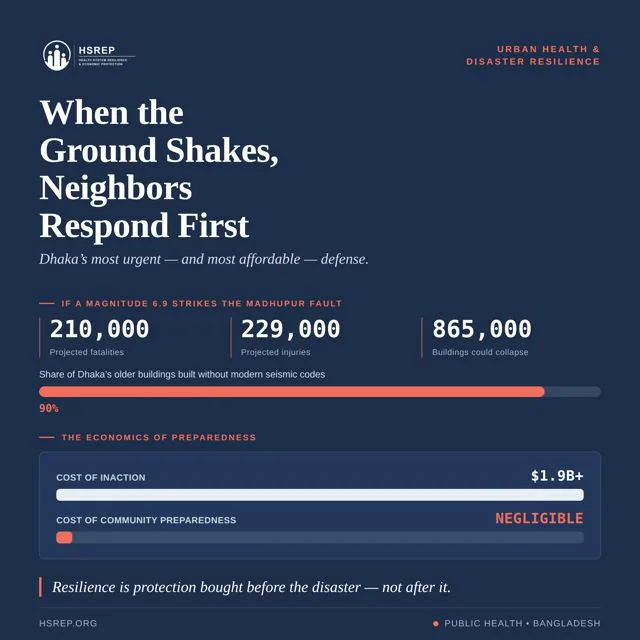
Seven arguments. Two countries. Zero dollars of paid promotion.

All nine pieces →
§ 02 · Findings

Four findings from the Season 1 data.

Eleven replicable patterns came out of the campaign data. These four held across chapters and across platforms.
FINDING 01
Tagging deepens a national audience rather than broadening it.
Evidence
≈3× median impressions on tagged Daily Star pieces, replicated five weeks apart, with a 76-80% Bangladesh audience.
FINDING 02
The same content reaches opposite audiences on different platforms.
Evidence
Same argument, same day: Facebook routed it to Bangladesh, LinkedIn to 61% health-domain U.S. professionals.
FINDING 03
Algorithmic recommendation is the gate to cross-border reach.
Evidence
Dose-responsive: 50%→47%, 60%→70%, 78%→82% U.S. audience as “Suggested” share rose.
FINDING 04
The campaign converged on its thesis by the close.
Evidence
The closing post was the only untagged article post where U.S. exceeded Bangladesh, 48.5% > 39.3%.
Three secondary observations and four further mechanisms sit alongside these, each with its claim, evidence and interpretation, in the Season 1 record.
All eleven findings →
§ 02 · Impact

Is anyone actually reading this?

The first question a professional asks about a platform they have not heard of. HSREP publishes the answer, including the parts that are not flattering.
86readers past thirty seconds
17past four minutes
217AI fetches a week
9clicks from Google search

Engaged readers rather than a visitor count, with datacentre traffic deducted and named. The record also carries what did not work: 4 people clicked through to the response form and none submitted one.

What the record shows →

§ 03 · HSREP Roundtables

Join the discussion, five minutes, on the record.

Three open questions, each answerable from your own work. Named contributors. A published synthesis.
Roundtable № 02Open · no closing date

“Where does preventive care break down between recommended and completed in your setting?”

Anchored to the Prevention Adoption Gap: 44.89% colorectal screening at the average FQHC, 48.74% in Michigan · two further questions are open on health messaging and the cost of care
3 questions open
✓ Real name & affiliation✓ Moderated✓ Best responses published

How a roundtable works

01
RespondOne question, five minutes, no account needed.
02
Moderated exchangeSelected responses receive replies and follow-ups.
03
Published synthesisOnce enough responses are in, conclusions and disagreements are published with named contributors, a citable record.
§ 04b · Professional reception

The signals behind HSREP, clearly labeled.

Reader prompt

“Are you maintaining a website where all this information can be found in one place? These efforts are extremely valuable and deserve to be easily accessible.”

Public reader comment · name not displayed
Season 1 · Chapter 6 thread, the prompt that helped shape this platform

Professional

1on record

“I chaired Shafaat's capstone, so I have followed this from the start, and it has grown into a serious, well-documented platform. He is careful about what the evidence can and cannot show, which is what makes the advocacy worth trusting.

“He also would not stop at the argument. The Prevention Adoption Initiative takes the hardest part of prevention, turning a recommended screening into a completed one, and treats it as something to design and test responsibly, with sustainability in mind.

“It is that pairing, credible advocacy and a real plan to act on it, that makes me glad to support the work and to encourage the right partner to take a serious look.”

Dr. Jeffrey Schulz
Professor of Public Health Education & Director, Office of Health Promotion, Eastern Michigan University

Institutional review

No institutional endorsement is claimed here. Organizations may review the evidence and decide whether to support, host, or challenge the work.

Request the evidence pack →
Named support is published only when it is verified, consented, and attributable. Reader prompts without a displayed name are labeled separately.
§ 05 · Applied initiative
Proposed · In development

Close the Prevention Adoption Gap

The first proposed demonstration is intentionally narrow: one Southeast Michigan safety-net clinic, one colorectal-cancer screening measure, twelve months, and an independent academic evaluation partner. The pilot has not begun.

Service redesign & friction reduction
Make the completed path the easiest one: mailed at-home kits, reminders people act on, a next step for every positive test.
One nightly file, three transparent rules
A 19-column coded export ranks who needs attention this week: days overdue, days since a positive test, prior no-shows. No model, no EHR connection in the first pilot.
Implementation enablement
Training so the site runs and sustains the routine itself by month twelve. Every lever is recommended by the Community Preventive Services Task Force.
Try the worklist →
The weekly list the pilot would run: thirty invented patients, three rules, nothing sent. Predictive and FHIR work waits for a validated pilot.
Two partners start it; a third carries it past month three. A safety-net clinic to host the pilot and an academic partner to lead the independent evaluation. A funder joins for months 4 to 12 if the feasibility phase shows the routine can run.
Request the presentation →
§ 04 · Participate

Choose the next step that fits.

The pilot needs a host site and an independent evaluator before it can start, and a funder after month three. The three roundtable questions stay open above, and the newsletter is there if now is not the time.
OPEN NOW · NO CLOSING DATE

Join the roundtable

Answer one focused question with your name and affiliation. Selected responses enter a moderated, published synthesis.

Add your response →
PARTNERSHIP · CONSIDERED ASK

Could you host or evaluate the pilot?

Start with a focused 30-minute presentation for your team. No commitment required.

Request the presentation →
FOLLOW · QUIET FALLBACK

Get the next opening by email

Season 2, new roundtables, and initiative milestones—a few times a season.

Share to LinkedIn X Facebook Email
§ 05 · Founder & principal
MD Shafaat Ali Choyon
Growth, Marketing & Public Health Strategist · MBA · MCIM · MPH · CHES®

Clarity under pressure that turns system complexity into measurable results.

Founder of HSREP. A growth, marketing and public-health strategist with sixteen years turning complex systems into measurable results, grounded in public health. HSREP grew out of a Master of Public Health capstone at Eastern Michigan University and now publishes independently. Background, standards and disclosures →

§ 05B · The mark

Three figures, one ring. The argument, in one image.

The Humanist Crest is protection built as a structure, with people at its centre. Its story is told in six chapters, scored to a theme written for it: We said we would not look away.

Play the theme34 seconds, in six chapters
§ 06 · Frequently asked

What HSREP is, in plain answers.

The questions professionals, partners, and search engines ask most.
What is HSREP?
HSREP, Health System Resilience & Economic Protection, is an independent policy-research and advocacy platform. It publishes health-system arguments, the central one being that health protection is economic infrastructure rather than a residual budget line, and turns them into materials professionals can use. The site lives at hsraep.org, the letters spell Health System Resilience And Economic Protection.
What does ‘health-system resilience is economic protection’ mean?
It reframes public-health spending as protection against measurable economic loss (medical debt, lost productivity, disaster cost) rather than a charity or cost line. Resilient health systems protect households, institutions, and public trust when a shock hits.
How can professionals engage with HSREP?
Professionals can respond to or endorse a published argument, join a structured online roundtable, subscribe to the newsletter, request a presentation, or explore partnership on the initiative.

More questions, including how HSREP is funded, how sources and corrections are handled, and who it is written for. The full set →